MEMORIES
Oberammegau Pigeon
An article submitted by Ralp Porter (ex Kohima Troop).
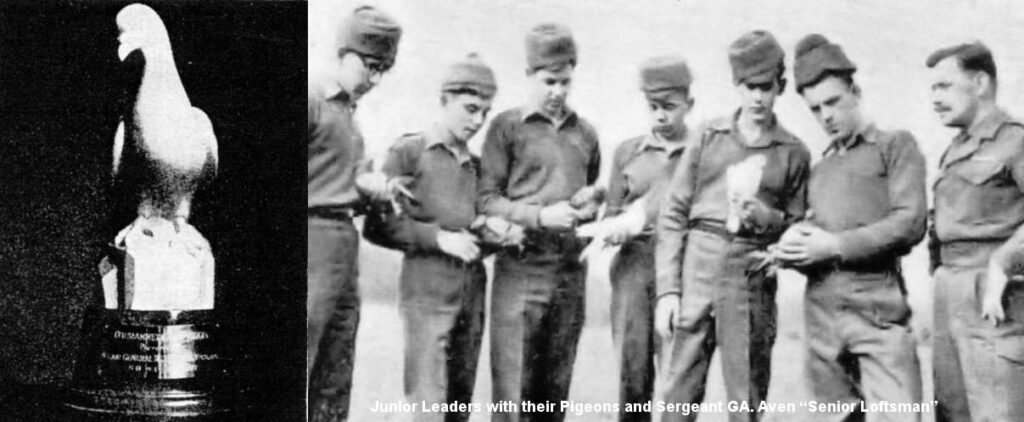
Last June, after visiting Denbury, Major-General R. J. Moberly, C.B., O.B.E., wrote to the Commanding Officer and said that he would like to present a trophy to the Regiment before he relinquished his appointment as Signal Officer-in-Chief.
Colonel Gregory suggested a “Pigeon Trophy” and asked the General to consider having the trophy carved in wood. Not only would such a carving be unusual, but it would be in keeping with other newly-received trophies. In his reply, General Moberly said he would be pleased to present such a trophy, but he did not want the finished carving to look like a crow.
FAUST LANG, of St. Ives, Cornwall, a distinguished artist-sculptor, was asked to undertake the work, but, unfortunately, he was leaving for Oberammergau a few days from then to be present for the Passion Play season. However, he said he could undertake to make the carving in Oberammergau, but that he would be unable to deliver it for several months, when arrange ments could be made to collect it from him. He was told to go ahead with the work and that, somehow, it would be collected as soon as it was finished. The collection of the beautiful carving, in white maplewood, was made the subject of an
“Adventure” for a suitable Junior Leader. Junior Sergeant Grant (now in manservice) volunteered to collect the trophy on his own, with no assistance from the Regiment. This is an account of his journey:
“I started out from Newton Abbot at four o’clock on Tuesday, 17th November, 1960.1 had hoped to catch the night train to Ostend, but I arrived too late. A railway carriage on Victoria Station was my bed for the night. The next morning I caught the boat train to Dover, and, after a calm crossing, arrived in Calais at about three o’clock. My route to Paris took me through Boulogne, Arras and St. Quentin. People who gave me lifts thought I was a parachutist, and I let them think along those lines throughout the entire journey.
“I started out from Newton Abbot at four o’clock on Tuesday, 17th November, 1960.1 had hoped to catch the night train to Ostend, but I arrived too late. A railway carriage on Victoria Station was my bed for the night. The next morning I caught the boat train to Dover, and, after a calm crossing, arrived in Calais at about three o’clock. My route to Paris took me through Boulogne, Arras and St. Quentin. People who gave me lifts thought I was a parachutist, and I let them think along those lines throughout the entire journey.
I arrived in Paris at one o’clock on Wednesday morning. While I was looking for a hotel a police van drove up. A man who was walking along about 15 yards behind me ran up an alley, which turned out to be a cul-de-sac. The gendarmes trapped the man in this alley; he surrendered with his hands above his head. The police then took both of us to the police station. They thought that the prisoner might have been tempted to relieve me of my wallet; he was an Algerian.
The Commissioner of Police advised me to spend the night at the station, as there would be no hotels open at that
time of night. The cell stank of its previous inhabitants, and in neighbouring cells were criminals and prostitutes. The next morning, after viewing Paris, I set out for St. Die, arriving at 19.00 hours. The towns in the area of Nancy and Epinal were the cleanest I saw in France. Having spent the night at the house of a young lady in St. Die, I proceeded through the Vosges Mountains to Strasbourg. Crossing the German border, I passed through Stuttgart and Ulm, and along the Autobahn to Oberammergau. Arriving there at 11.30 hours, I collected the pigeon, which was the object of my journey.
After having lunch with the wood carver, I climbed a mountain and took some photographs of the scenery. I then went to the U.S. Army base at Oberammergau, where I obtained a lift to an Army base at Munich. On the Saturday morning most of the helicopters left on a search mission as a ‘copter had crashed three days before. I managed to get a lift in a jet-engined helicopter which was en route for Verdun, and I was dropped off at Stuttgart. I spent the weekend at Stuttgart, and ‘Americanized’ with the Americans stationed there. There was a training flight leaving for London, via Brussels, with which I got a lift on Monday morning. When we were flying over the Channel I was silting on a ‘Mae West’ with a parachute on my back (which I hadn’t the remotest idea how to use). We touched down at Gatwick Airport with a flat tyre – that was really a terrifying experience!
After seeing Major-General Moberly at the War Office, I returned to Denbury Camp with the pigeon. I had been away only one week, but had sufficient experiences to last me for a lifetime”
The Oberammergau Pigeon Trophy has inspired individual troops to obtain, breed and train there own pigeons. Unexpected difficulties in breeding and training, all through inexperience, are being overcome, and now that short distance races are being held, we hope to have our first Whitehall/Denbury race in August of this year.
It is hoped that General Moberly will be able to start the first race from London and present the trophy to the Winning Troop.